
My conversation with a dead guy about house church
I was surprised, both to be talking to a dead guy and to hear his view about a church in a home
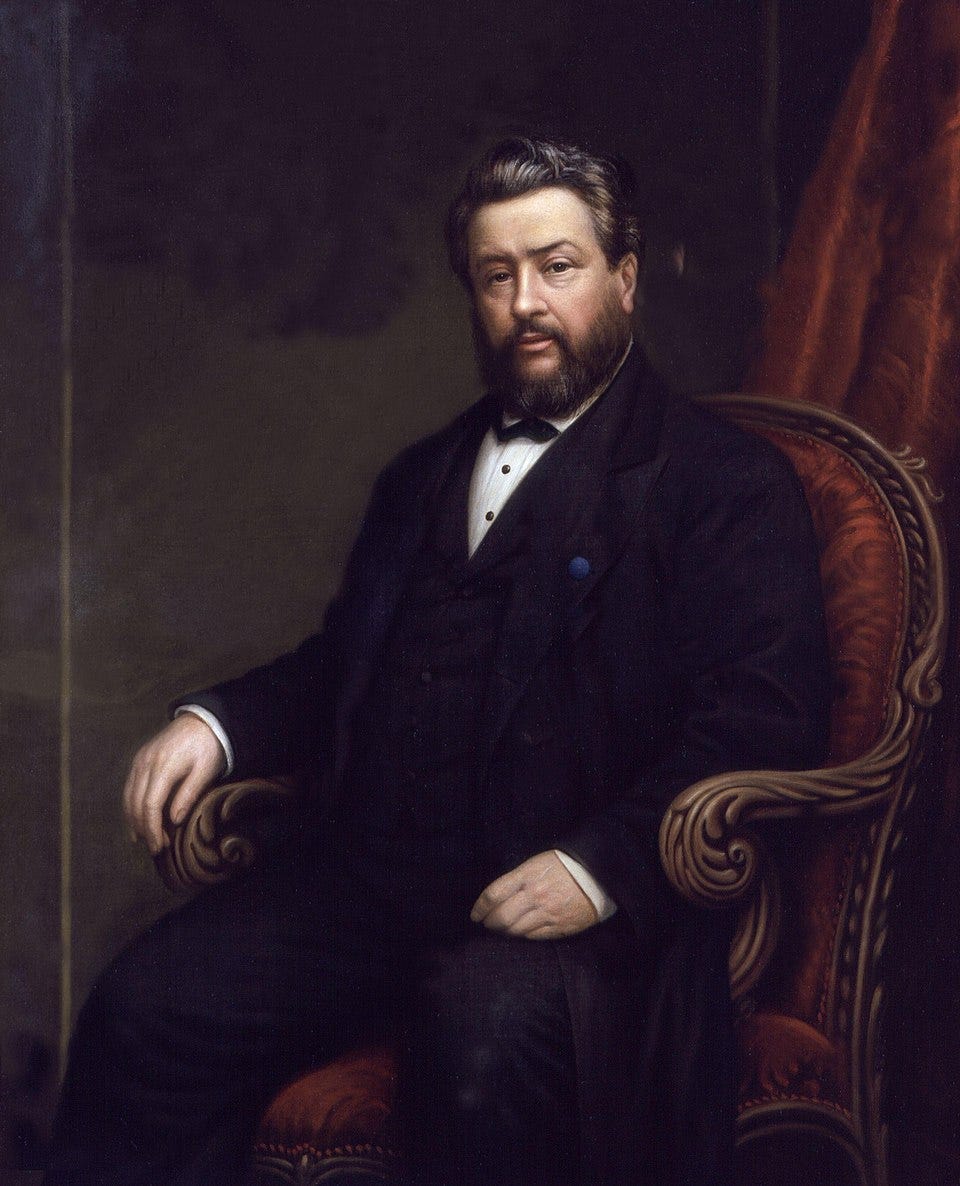
Sometimes you run across a really wise but dead guy who has some amazing things to say. I met a bearded fellow recently as he was preparing a sermon from Philemon verse two: “The church in thy house.” (I could tell he was old because he used the word ‘thy’, otherwise, his sweet beard fit right into modern day.) This is what he had to say:
Some interpreters have supposed that a small congregation met for worship in a room in Philemon’s house, and there is tradition that such was the case for some considerable time. The churches established by Paul were, at their commencement, for the most part small. … Philemon, therefore, might have literally have had a church in his house, and a congregation might have gathered there.
It strikes me that there would be a great deal of good done if persons who have large rooms in their houses would endeavour to get together little congregations; there are many, even of our poorer friends… who might promote a great blessing if they occasionally opened their houses for a prayer-meeting or religious assembly. We need no consecrated places for the worship of God.
Certainly, our text does not give any countenance to the calling of certain buildings “churches.” … If I ask for “the church” in any town, I am forthwith directed to an edifice, probably with a spire or a steeple, which the inhabitants call “the church.” Why, they might as well point me to sign-post when I asked for a man; a building cannot be a church. A church is an assembly of faithful men, and it cannot be anything else. I cannot see how such a piece of architecture as we now call “a church” could very well have been in Philemon’s house;… The fact is, it is a misnomer, a misuse of language; and we must mind that we do not get into it.
However, it appears that Philemon had a church in his house, a church largely, if not exclusively, composed of his own family; that he was privileged to possess a godly wife, the beloved Apphia; that their sons and daughters walked in their parents’ footsteps; and their their servants, and even their vistor, Archippus, were members of this church which was in the house of Philemon.
Wow. I’m not used to finding many old guys speak out so boldly about house churches, what’s your name?
Charles Spurgeon. I passed way in 1892.
Mr. Spurgeon, have you seen this video?
(Seeing as he had died 113 years before YouTube, he had not. I post it here for you to review:)
After his first experience on YouTube, Spurgeon was eager to get back to writing his sermon:
Now let me attempt to describe a church in a house; meaning, all the while, to be asking you whether you have a church in your house. A church, according to the New Testament, consists of converted persons, or persons who profess to be converted. No visible church is absolutely pure; a church must be taken upon its own profession, consisting as it does of persons who avow themselves to be followers of and believers in Christ,
That sounds a lot like “repent and believe.” (Acts 2:38)
But it strikes me that a number of converted people are not necessarily a church; but in order to form a church, they must worship together. Happy is the household which meets every morning for prayer!
And that sounds like “worshipping the Lord” and “being devoted to prayer.” (Acts 2:42, 47)
But there must be something more than this before there can be a church. A church is not merely a company of people meeting for worship; there must be some bond of unity.
Ah, being “devoted to fellowship.” (Acts 2:42)
At this point, I interrupted him again:
Excuse me, Mr Spurgeon, because a lot of contemporary authors and pastors have a specific problem with house churches. What do you have to say about leaders and shepherds in a house church?
And to make a church, there must be oversight. A church is not a complete church without a pastor, its elders and its deacons. A church in the house will have its elders. There need not be any election of these, because they are elected already. Sometimes the oversight of the household will fall to the lot of the eldest son, or daughter, and sometimes some long-abiding servant, some old housekeeper, becomes virtually the presiding genius. There must be oversight, and God sometimes graciously sends to families those who are more advanced in spiritual things, who become, as it were, the officers of the church in the house.
Thank you, that clears things up. It sounds like oversight in the same way the apostles provided oversight in Acts 2:42.
A church in the house must, of course, be furnished with instruction. One of the first reasons why there is a church at all is to teach the members. We are formed into churches for mutual edification. … Let Christian parents, forming a church in their house, look to the formation of the character of their children, especially their converted children, and let them not overlook their converted servants.
What if I still have questions about how this church-in-a-home thing should work?
I think I have now described the church so far as its organization is concerned; but I cannot very well describe it all. You must go and live in the midst of such a church to understand thoroughly what it is like.
Oh wow, I have a friend who told me that exact thing. He said that he understood the idea of a simple house-church gathering on paper, but it wasn’t until he experienced it that he felt fully equipped to lead a church in a house and train others to do the same. This was an important lesson for him to learn because he was headed to a context where ‘edifice’ style churches were subject to persecution, but house churches could stay under the radar.2
One more thing. A church is really worth nothing at all if it does not try to extend itself, and a church in a house is no true church if it be satifsied without endeavouring to bring in every member of the family. If you have half a dozen converted, and there are seven of you, never leave off praying till you have the seventh… what a world it would be if there were such a church in every house! It would be heaven begun below!
That reminds me of two things: First, Jesus asked us to pray that his kingdom would come on earth as it is in heaven (Matthew 6:10). Second, it sounds like you’re describing the Lord adding to the church’s number through His people praying and engaging those outside the church (Acts 2:47).
Having thus described a church in a house, I propose … to pay you a pastoral visit.
(Wow, this got deep.) Um, Mr. Spurgeon, you’re coming to my house?
I am going to knock at your door, take a chair, and sit down and ask you a few simple questions. The first is, Have you a church in your house?
Well, we have several Christians in our house, but I cannot say that there is a church there.3
May I tell you what I suspect is the reason why there are so many houses that have Christians in them, but no churches? It often is because those Christians are inconsistent. … One of the worst evils we have to deal with, as Christians, is the evil of inconsistency at home. … And you Christian people in households, do seek so to act that you may not be a disgrace to your profession, but may form a true church in the house where you dwell together.
Thanks for sharing these thoughts and challenging me Mr. Spurgeon. Have you any final comments?
May God grant us grace so that we may all of us be able to say that we have a church in our house! “Believe in the Lord Jesus Christ;” this is the foundation of the church, and they who have believed are members of Christ’s Church.
This “conversation” was adapted from C.H. Spurgeon, “A Pastoral Visit,” in The Metropolitan Tabernacle Pulpit Sermons, vol 54. I found it in “Voice: An Independent Church Journal” March/April 2023.
Told you it was a sweet beard.
One of my disciples, who is now engaging unreached peoples in South Asia told me this very thing after being in our house church for a season.
This quote is from Spurgeon’s sermon text (the only one of my dialogue). But it fits pretty nicely, don’t you think?